
Sparked
The last person I expected it from.

In 2004 the union launched an experiment: it pulled two thousand members out of their buildings, schools and healthcare facilities, using their union contracts to leverage leaves of absence, and hired them to campaign for John Kerry in his bid to become President of the United States.
This army of workers were named Member Political Organizers—MPOs for short. Kerry lost, most went back to their Company, but the badge stuck. From that point on, anyone who kept showing up for phone banks, door knocks, or Get-Out-The-Vote drives was often called an “MPO.”
Four years later, in the run-up to 2008, the union gathered more than two thousand of its most loyal MPOs to a ballroom at the Washington Hilton—sometimes called the Hinckley Hilton by us organizers as we prepared for the conference. The purpose of the event was equal parts audition and expression of loyalty: small focus groups with the Democratic contenders for President and a central rally to size them up.
The room split along lines you could read from the seating chart. East-coast locals near the doors wore Hillary pins. West-coast tables supported John Edwards. And front-and-center, sat the Midwest bloc—our bloc—led by the president of my own multi-state local, all in for Barack Obama.
Everyone wore the same purple t-shirt.
My job was to coordinate the involvement of our local’s staff and members (MPO’s), assist in the formation and execution of the focus groups, and make sure everyone had signs with Barack’s name on them to wave when he came into the room.
As the lights were dimmed, the national leaders of the union spoke to the crowd to let everyone know what the priorities were — what we wanted to hear from the candidates. And then it began, one candidate after the next took the podium, the room was lit with purple lights and totally electric.
My former boss and mentor, G.M., the state political director for Illinois, had the privilege of advancing Senator Obama. I remember the very serious look on his face as he cleared the path, across the room and up the middle, and just past our local—and local leader—up to the stage.
Our duty done, it was time to watch. G.M. and I moved to the back of the room to a mini-stage. We often did this whenever we built, or assisted in building, one of these elaborate machines—conferences, rallies, conventions—we always retreated to watch it run. Professional onlookers, silent partners in the choreography.
We observed professionally, the protocol was simple: every time a candidate said anything favorable, the handful of national leaders behind them on the stage would stand in unison and clap. And the crowd followed instantly. More than two thousand purple shirts jumping to their feet, sometimes led in a chant of the union’s initials, frantic with their yard signs waving. The crowd was charged and robotic at the same time.
None of them wanted to be the one who didn’t stand, the one who hesitated because maybe, just maybe, they didn’t agree on every single point. Approval wasn’t individual; it was collective, instantaneous, competitive. Who could leap first? Who could shout loudest? The leaders clapped, therefore we clapped. The leaders stood, therefore we stood. The leaders decided what was important, and their power was the only currency that mattered.
All wanted to express that he or she completely agreed with the union’s position. The leaders’ position. Really, the leaders’ authority.
We watched peacefully, with surety. After years of conditioning them we knew exactly how the MPOs would respond to the prompts, and this took the anxiety from us. I had always valued these times shoulder-to-shoulder with my former mentor — but that night we were both standing observing with heightened awareness of the eeriness of what was before us.
As we watched intently the electrified, dark and purple-lit ballroom, it was a sea of purple shirts chanting repetitively for the millionth time. And then, after a series of standing ovations the room was silent so all could hear the next line from the speaker.
Right then, G.M., my mentor and respected architect of political power at every level of American government, sparked my awakening.
He leaned toward me in his trademarked sway… and with what seemed to me, as someone who knew him better than most, to be regret, maybe even sorrow, he looked me dead in the eyes and clearly said, “Pretty Orwellian, isn’t it?”
In that single sentence, it was real.
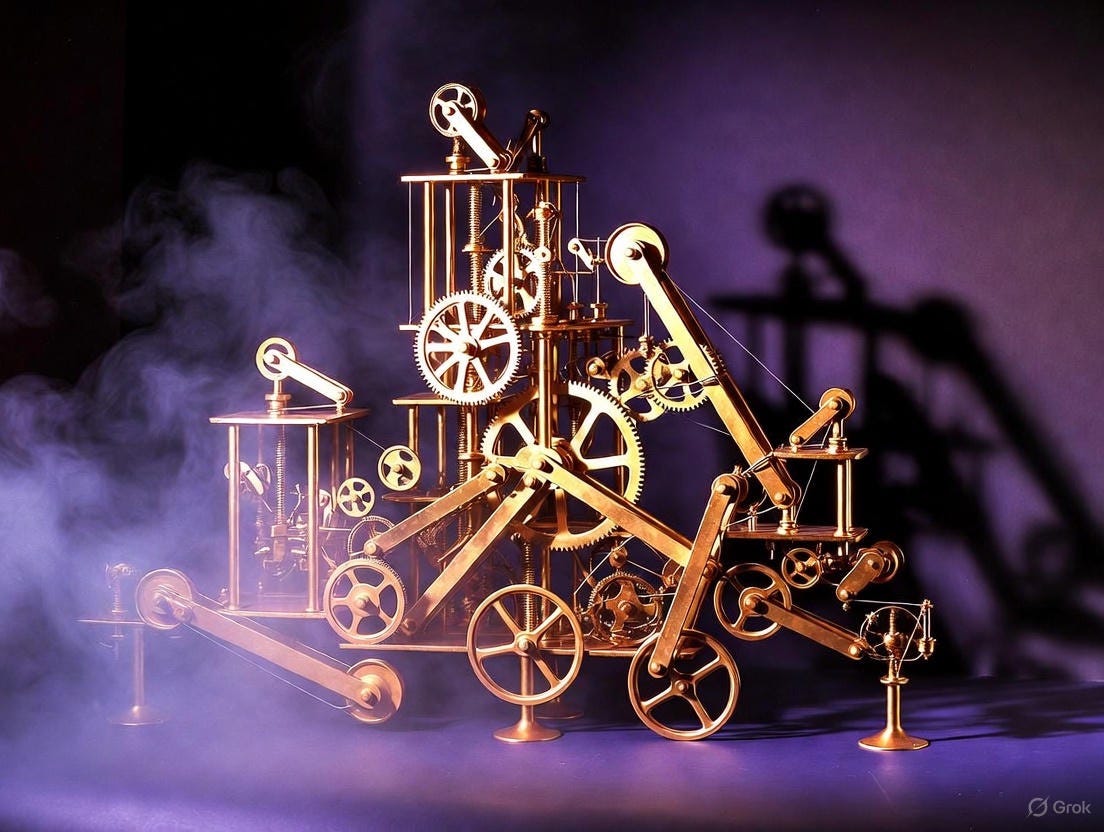
The scales truly tipped. I wasn’t watching democracy in action. I was watching the dress rehearsal for the revolution the leader had promised me was “almost here.” The room full of chanting purple shirts suddenly looked less like enthusiasm and more like obedience. The Rube Goldberg apparatus we’d built wasn’t empowering anyone; it was running them.
And for the first time I saw the endgame clearly: not wages, not benefits, not even the candidate on stage. Just compliance. Perfect, predictable, endless compliance.
This is REALLY good writing!